
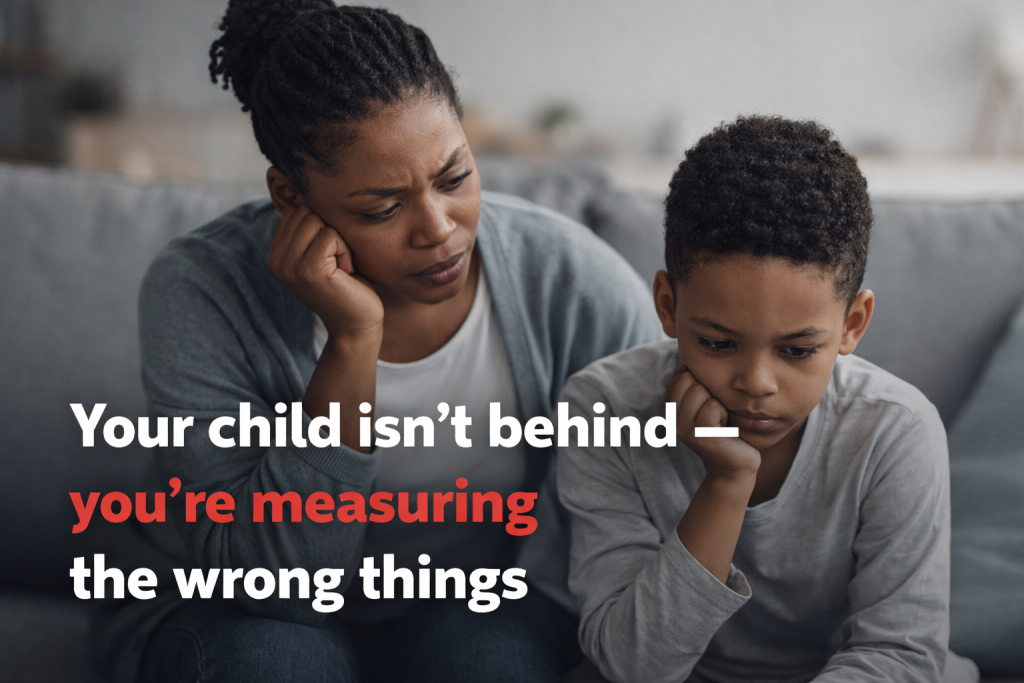
Everywhere you turn, some child is ahead.
Somebody’s child is already reading, another is speaking confidently, and another is “very sharp in responses.”
And quietly, a question starts forming in your mind:
“Is my child falling behind?” You may not say it out loud. But you know you feel it deep inside you. But the problem is not that you’re comparing; the problem is what you’re comparing.
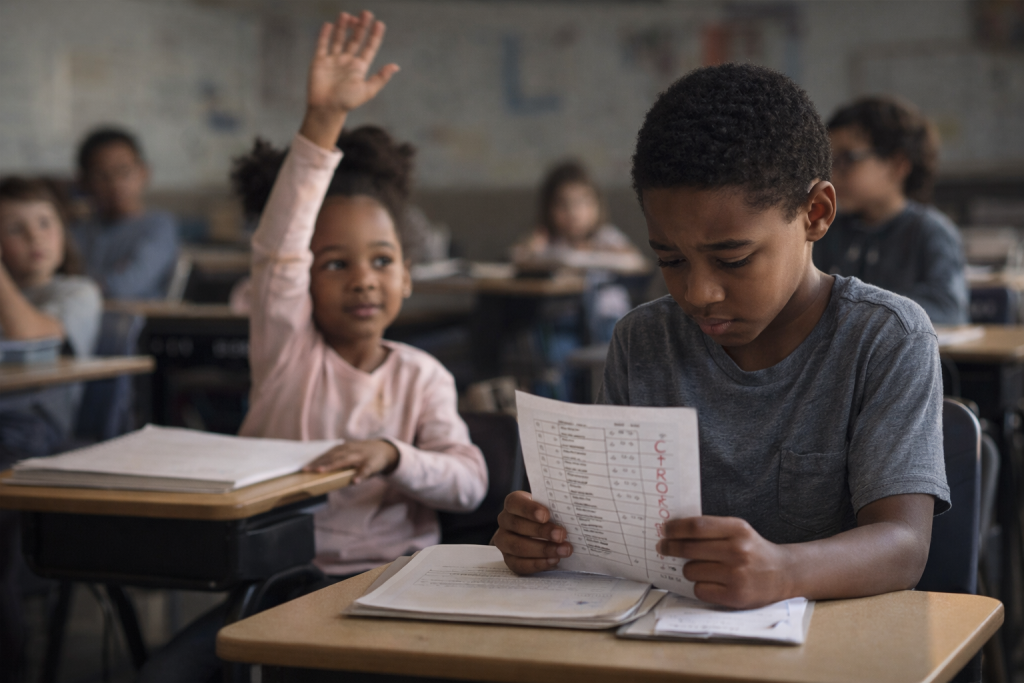
We’ve reduced children to performance metrics. We judge how fast they answer, how early they start, or how quickly they “get it.” And because those things are easy to see… we assume they are what matter most, but are they?
A child who answers quickly is not necessarily thinking deeply. A child who speaks confidently is not necessarily understanding better. A child who performs early is not necessarily developing well.
But those are the children we call “ahead.” And put pressure on the ones who might be taking time to build something deep.
Let me turn your mind a little to something better to look out for. Can the child stay composed when things don’t go their way? Can they think through a problem without collapsing? Can they make a decision without looking around for approval? Can they handle correction without shutting down or cowering in their pants?
These skills may not be loud. They don’t impress people quickly. They’re not the flamboyant things we see and make the ‘awws’ for, but they are the things that carry a child through life.
And this is where many parents get misled. You see another child performing, and you begin to adjust your child. You begin to push a little more, correct a little more, and even compare a little more. And you ignore all the signs of pressure the child is sending out not because you are careless, but because you are trying to help. You’re looking out for the best of the child. But help based on the wrong measurement. becomes pressure. In some children, it builds resentment, and they detach from you. And then you start asking yourself, “Where did I get it wrong?”
This is what you need to know: Some children peak early. They adapt well to structure. They respond quickly. They look impressive in environments that reward speed. But when life demands depth, when things are not clear, when pressure increases, they might struggle in ways that surprise everyone.
Other children might not look impressive early. They can take their time to show impressive traits. They observe. They process. They don’t always respond when expected. They are the ones people worry about. But give them time; they begin to think independently. They become stable.

They develop a kind of clarity that cannot be rushed. They actually manifest a high level of intrapersonal intelligence and can manage themselves and become better. And suddenly, the child who looked “behind” is no longer behind. He seems to be an example for other children around him.
Now, a bit about me. I remember being that child in some metrics. I read pretty early, but when it came to physical activities, my peers did better, and the older children laughed at me because I would struggle to catch up. I preferred to be alone, be with my thoughts, and explore. And adults who came close to talk with me were very impressed. But imagine I had parents who were sporty and thought I was backwards. Thank God I didn’t have such parents.
Now, looking at me today, I like to believe I’m not behind, am I? 😃
So the real question is not, “Is my child ahead or behind?” The real question is, “What is my child actually developing?” Because once you change that question, everything changes. You stop chasing speed. You start paying attention to depth. You stop reacting to other children. You start understanding your own.
And when that happens, you don’t just raise a child who is ahead for a moment, you raise a child who is prepared for life.
Your child isn’t behind. You’re just being shown the wrong scoreboard. You might be focusing on the wrong things.
And one final point. This is not to discourage you from seeking improvements; there’s a lot of it to be done, and I wouldn’t be here if it were otherwise. This is just to encourage you to soft-pedal on the pressure.
If this made you pause and think, stay close.
I share simple, real insights on how children grow and how to guide them without confusion or pressure.
About the Author
KC Umeh writes about how children actually develop, beyond performance, pressure, and comparison.
He helps parents understand what is really happening with their child so they can guide them with clarity, not confusion.
He is also passionate about building outstanding marriages and helps hundreds of families around the world build exceptional humans.